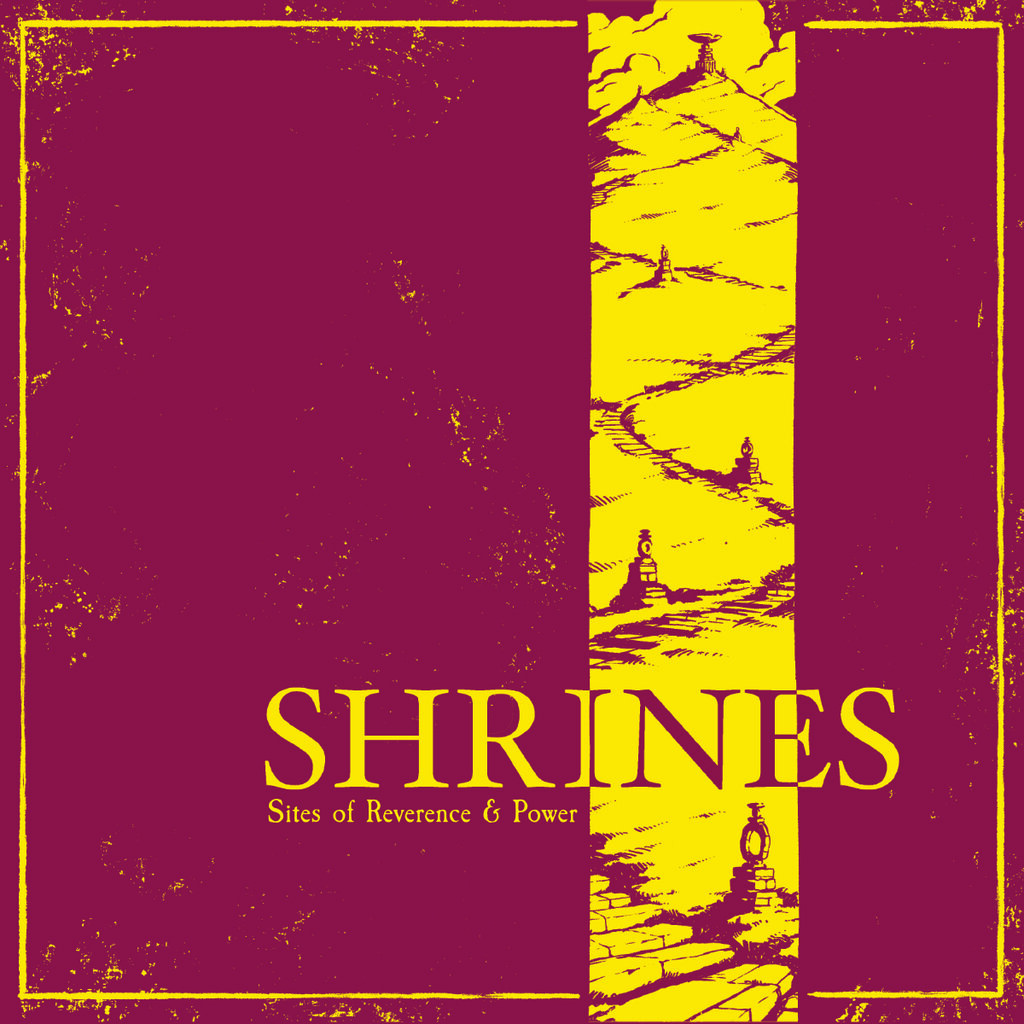
A system-neutral, Himalayan Buddhism-inspired sourcebook of holy sites for analog adventure games.
Latest Updates from Our Project:
Gameplay Tools section PDFs
over 1 year ago
– Tue, Mar 25, 2025 at 01:41:12 PM
Venerators!
The Gameplay Tools section is the book's first to hit 100% (pre-polish, anyway—I'm sure we'll tinker). Please share with me any feedback you may have by commenting on this update or by posting in the Discord server's #WIP channel.
For visibility, the vignette section is close behind, the intro's refining, and the essay is on draft three. Onward toward fulfillment.
In touch, as always,
James
System Reveal: Pilgrimage
over 1 year ago
– Sat, Mar 15, 2025 at 02:03:04 PM
Venerators!
When I said "I'm delaying this book to include more gameplay tools," this is the biggest and coolest example of what I meant. I've designed, workshopped, discarded, and redesigned this system multiple times now, and while it's possible some revelation or intervention will change the details, you're looking at the end of a long and proper design process.
Pilgrimage
I give you Pilgrimage, a portable roleplaying system for spiritual character development over 3-5 sessions of travel to a holy site. The book contains plenty of those sites (plus generative worldbuilding tables, theory, etc.) that all furnish GMs, but this design helps players explore spiritual themes at the character level. If stories emerge through play, that's where narrative systems shine—and we should help unburden GMs anyway.
Worksheet Cards
The system gets two full spreads in the book's Gameplay Tools section for unpacking the ambiguity (What is "Ego?" What counts as "harrowing?"), but the above are both sides of an A6 worksheet card that players can mark up alongside their character sheets to track a pilgrimage's progress.
I'll be printing these on A6 card stock at Fireball Printing in Philadelphia, which a handled previous game of mine called HEARTSWEAT at the same specs.
I hope to include one card with each Kickstarter delivery. Regardless, EM|NCD's itch.io page will offer a black-and-white, printer-friendly version for free.
On System-Neutral Design
Developing this system spotlit the inherent difficulty of system-neutral gameplay design for TTRPGs. In short, it seems to be all about self-containment. If the tech is truly portable between different games, it can't rely on quant from any one of them. Its inputs and outputs—the two points where it interfaces with broader systems—both benefit enormously from abstraction, which is to say outsourcing the compability step to human brains. That's a feature, I think—part of the fun—since abstract narrative is tabletop roleplaying's value-proposition over video games.
Given a character with spiritual dimensions, this system is basically:
INPUTS: Decide when gameplay events count as "harrowing" (abstract!)
PROCEDURE: Increment a sub-stat, roll some dice, analyze results (concrete)
OUTPUT: Roleplay changes in your character's spirituality (extremely abstract)
I wonder how long this pattern will hold true in my work and what it means for narrative systems design across media. You couldn't do this in a video game, but then again, you wouldn't try.
Anyway, thanks for reading. Here's the perennial Discord link for those who may wonder, say, what the last shrine in the book looks like, how Taoism and Buddhism relate, or what my organic farmer friend is gonna do that with that one steep hill.
In touch, as always,
James
Art is officially locked
over 1 year ago
– Wed, Feb 26, 2025 at 10:52:30 AM
Venerators,
This update is short but monumental: Conner, our exceptional artist, has completed and delivered the book's illustrations, tables, and decorative elements in their entirety. Art for the project is now officially locked.
Layout of the print-ready manuscript has long been underway, but now it's snapping into place with final assets—and quickly.
Textless spreads in Affinity Publisher
Development updates should end soon, and then manufacturing updates will begin. I know that this is all happening much later than projected, but I promise you're getting more book than you backed, and I'll stay in touch every step of the way.
With great enthusiasm,
James
Table Reveal: Shrine Generator
over 1 year ago
– Tue, Feb 18, 2025 at 12:18:10 PM
Venerators!
Please forgive our silence. We've been hammering away, and now there's something new to show you.
Generator Tables
This book's Gameplay Tools section begins with procedural, generative tables for creating and populating your own sacred scenery. After weeks of exploring table styles with Tibetan-inspired decorative elements, layout for these tools is functionally complete (I'm sure we'll make some tweaks).
Saving the other tables for release, here's the book's biggest and baddest: a full-spread Shrine Generator. The curation of these parameters is a load-bearing pillar of the book at large for the historical, functional, and mythological scopes they define. This should be a reasonably exhaustive range of what shrines can be. As always with generative tables, this is a worldbuilding tool, which means it aims to prompt your imagination with cool possibilities and then get out of the way.
The Gameplay Tools section will also contain the following procedural tables:
Visitors
Role
Attitude
Rituals
Action
Object
Plus a non-procedural table for Atmosphere containing five Details for each of the following Tones:
Tranquility
Doom
Vigor
The Sublime
Hope
Discord Link
As always, please join us on Discord if you're inclined to discuss and see more of this project.
In touch,
James
Color adjusments for readability
over 1 year ago
– Thu, Jan 16, 2025 at 03:13:27 PM
I wanted to get this one quickly, lest fear and doubt take root.
Colors
First of all, thank you to the commenters who, with admirable politeness, noted that the layout samples I shared yesterday were too harsh on the eyes. I actually agree and have been quietly expecting changes to these colors for some time. A readability pass was always going to happen—probably in conjunction with final content reviews and coordination with the printer—and its arrival now just means the end is truly near.
Tl;dr: I will work closely with the printer to ensure this book's readability. I didn't write all these fancy words for them to hurt the reader's eyes. The colors we've been using look beautiful in illustrations, but if you wouldn't read an essay in them they are not right for this book.
Revisiting the list of inks that our printer offers, here's my current thinking:
Conner and I dig this new pairing quite a bit, however it is also not necessarily final. We'll continue experimenting, which of course includes another physical test-proof. A different color and/or typeface for the body text are also on the table.
I can't overstate how much I, the writer, value readability, so please trust that I'll contort into an Uzumaki spiral if I must to deliver.