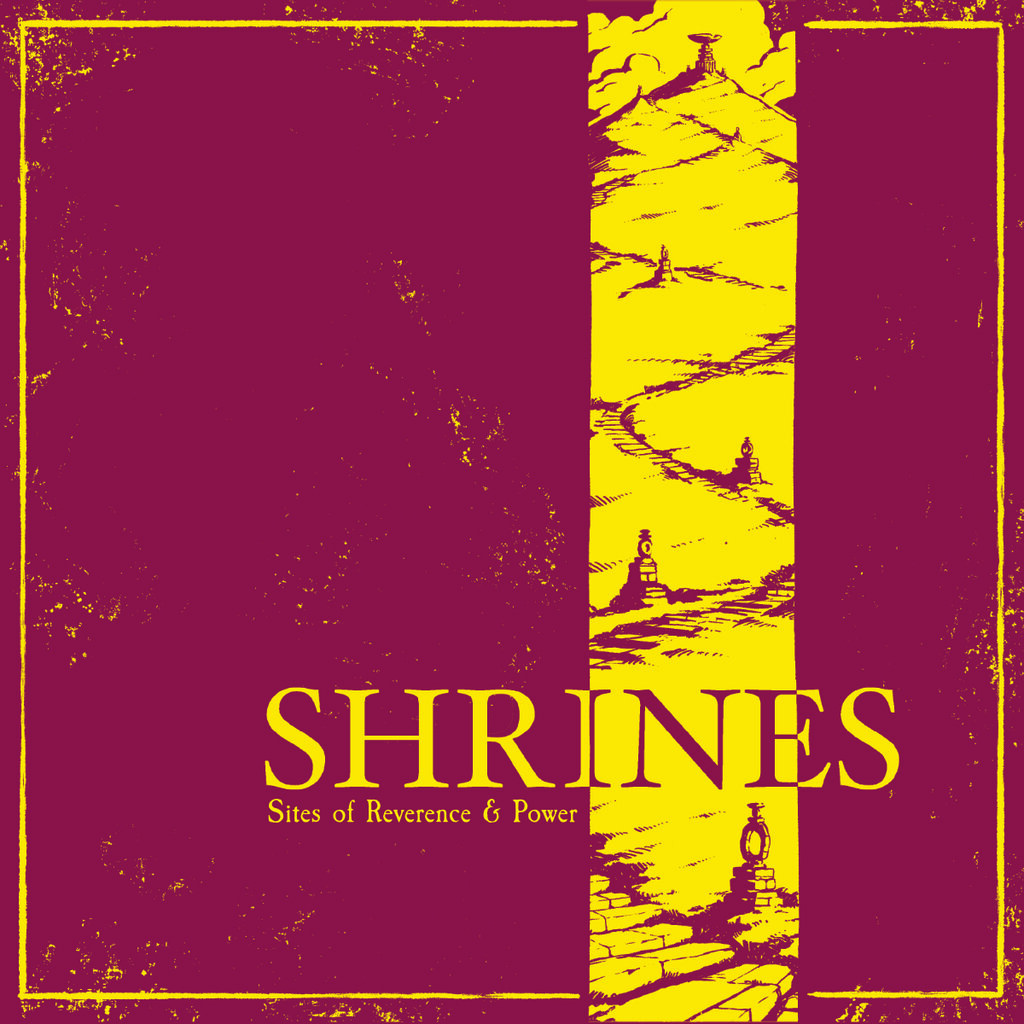
First Physical Proofs
about 1 year ago
– Tue, Jul 22, 2025 at 01:27:55 PM
Veneradores,
Tenemos las copias primeras del libro que—*SMACK*, I mean, hello, it is I, the writer and publisher of a book that I am suddenly holding. Behold, which is to say hold it with me in the distant way that you can, knowing first a few things:
- The proof came unbound, just a bunch of loose pages. I tried to hold it together, but please expect no tidiness in these pictures.
- We haven't seen the foiling yet. Your copies will have foiled details on the cover.
- iluvm
I have a few notes for the printer, so we'll do another round of this, but for the most part I'm really happy with how this looks and feels!
To say a little, it looks sharp, it feels heavy, and I'm surprised to be surprised by the scale in these compositions. Art and text alike are big and accessible, as if this were a picture-book for kids, and there's something delightful and fresh about that. I can imagine reading it in bed, sinking into a vignette as the day recedes, and that's exactly the kind of immersion I aimed for.
It's giving Wanderhome, as the kids might say, and my goal now is to earn a fraction of that audacious, aspirational comparison.
Shipping
Again, please be ready to confirm your address and provide payment for shipping. We can calculate package weight now that we have a physical proof, so that email is no more than a week away. In it, assuming nothing unforseen, anyone who wants to upgrade their order—say, from digital to physical—should be able to.
Turnaround might be tight, but August fulfillment is still my goal!
Thank you, as always, and in touch again soon,
James
Digital version 1.0.0 available for download
about 1 year ago
– Mon, Jul 07, 2025 at 08:00:27 AM
V E N E R A T O R S,
~1.5 years (!!!) after you all entrusted me with funds to finish this book, I release to you, its most patient of backers, digital version 1.0.0.
Digital Downloads
The following links will take you to separate itch.io pages for Shrines and SANCTUM, which contain their respective digital files. Using your email addresses from the Kickstarter campaign, I've generated download keys that access the digital rewards in your backer tier.
How to Download
For security reasons, you'll need an itch.io account to activate your download keys. Most importantly, this account must match the email address you used to back the Kickstarter campaign. Please verify your Kickstarter account's credentials before making your itch account. I'm sorry for this clunky, annoying step, but it keeps things clean and secure.
Contents
A couple notes:
- The Shrines PDF shows spreads, not pages stacked in sequence, because we designed much of the art and layout—especially the shrines vignettes themselves—to splay across two pages. The reasoning should be obvious in context, but it's an unconventional choice, so I felt like calling it out.
- We'll definitely tweak Shrines before moving to print, but we're talking minor formatting adjustments—the book is very much ready for readers—and your download keys should work for all future versions I upload to the page. If that ever proves untrue, please reach out to me, and I'll send you whatever.
- I've included a printer-friendly, full-page version of the Pilgrimage system's worksheet that all backers of the physical book will receive as a full-color A6 card.
- If you spot any errors, please let me know. Jeremiah, the editor, and I have been crawling through the book all week, but that actually blinds you after a while, so random typos are possible.
Thank you a thousand times, and I hope you love what you read.
Physical Printing
This month, assuming no issues on the printer's end, we'll be printing all physical rewards. This includes both editions of Shrines as 70-page paperbacks, SANCTUM as an A6 booklet, and the Pilgrimage worksheet as an A6 card (the t-shirts have been done for a while).
Given the printer's quick turnaround and in-house shipping, fulfillment is on-track for August.
Please watch for incoming emails about shipping to confirm your address and collect payment. You should also be able to upgrade your order to include physical copies of Shrines or Sanctum (but not shirts; the shirts are done).
Again, thank you for backing this project. It's the press' first major release, and I'm doing much of this for the first time, so I know how bumbling it must've looked. You're all as kind and magical as Saint Dolma.
In touch again soon,
James
Writing Complete, Edits Received—Digital Proof Inbound
over 1 year ago
– Mon, Jun 30, 2025 at 10:16:09 AM
Inches from the end, my friends.
Last week I finished the essay, passed it to cultural consultant James Mendez Hodes, and incorporated his notes. Now that our editor, Jerimiah Goad, has finished his pass, I have one last round of notes to incorporate—and then I'll be sitting on the book's first complete draft.
In the next week or so, you should expect to receive:
- A link to download a full digital proof
- An email seeking your shipping address for fulfillment
It feels wild to finally arrive. Thank you again for your heroic patience, and I hope you love what you read.
In touch again soon,
James
Essay Excerpt: The Cultural Production of Sacred Space
over 1 year ago
– Mon, May 26, 2025 at 10:45:02 AM
Venerators!
What is James even doing, you might ask. How is this book not done? Well, James is writing this essay, and thereafter the book will be done. James has rejected and restarted this essay about four times because the subject is complex, scholarship takes work, and the feedback so far has, to be gentle with myself, encouraged a more accessible voice and more obvious utility to tabletop roleplaying. You'll see little of the latter here, but having nailed this language down (specifically having found semiotics as a framework that's as useful as but less alienating than Buddhism's formal terms), the rest of it is coming fast.
Essay Excerpt
Here's the first part of the likely-three-part essay that concludes this book.
Part 1: The Cultural Production of Sacred Space
"If ceremony sanctifies time, sacred architecture sanctifies space. Its volumes conjure the sacred within the mundane the way political borders conjure states from the wilderness. Both cases contrive an abstraction: nothing a priori or even tangible announces space itself as sacred or under some particular governance. That relies on semiotics, or signage and its interpretation into meaning (citation). States erect literal signs, but sacred architecture signs mostly with aesthetics: form, material, iconography, perfume, melody, and other sensory cues articulate ideologies about the sacred’s nature. Venerators construct sanctity in response as both abstraction and concrete experience, interpreting the signed ideologies within the context of their own. Sacred space is therefore as much reaction as declaration—a conversation between architect, clergy, venerator, and even secular witness.
The ideologies of sacred space derive from (and develop) spiritual traditions: Cathedrals mimic the cruciform to invoke and subsume visitors into the death of Christ; wabi-sabi gardens welcome accidents as texture to emphasize impermanence. These details require their cultural context for meaning. Without its builders, we would recognize an extraterrestrial temple only insofar as its ideologies resemble those of Earth. We in fact project our ideologies by assuming temples (or any other type of building that we recognize) as options at all. Fear, love, and awe—basic components of sacred experience—require mutual understanding to elicit, but signing and interpreting specific spiritual doctrine leans on shared, if not imposed, historical knowledge. Consider how tour guides grant access to ancient ruins that might otherwise just be rocks.
This of course relegates the sacred itself to social production. Sanctity simply lacks ontology without beings to declare it and others to not just understand the declaration but agree. Sanctity emerges from instruction and participation like fun at a party or propriety at dinner. It’s a vibe, each instance unique and contextual to the signs, those interpreting them, and the conditions of that encounter. Even solitary mystical experience interprets through the mystic’s cultural framework. Christians in deep prayer encounter Christian saints, not Muslim or Hindu ones (unless mingling with those traditions). Spiritual nonconformists, and especially iconoclasts, presume the ideologies they reject. Even that fear, love, and awe that we call sacred experience and which amoebas might feel in glimmers depends on socially-dependent narrativization to qualify.
This is all to say that engaging with sacred architecture co-produces elaborate aesthetic takes on meaning, on holiness—that the sacred part of those spaces relies as much on tradition or natural form as the values that venerators bring within them, and that each of these contemporary negotiations is a collaborative act of creation between all beings involved. Holy sites would cease being holy if we all agreed (because their holiness emerges from agreement), which means we produce their holiness anew with each visit, recollection, or reference—instances that cannot possibly equate as the world and we ourselves permute through time. Veneration is generative conversation, a bridging of cultural contexts to not just describe but realize preeminent importance. Let this not denigrate the sacred as arbitrary, but exalt our creative powers as sentience in an interdependent world."
Parts 2 & 3
I needed to lay the above groundwork for what follows, for what I'm writing now:
- Shrines as hyper-localization of sacred space, and thus hyper-specification of its ideologies
- How all of the above plays out in interactive genre-fiction, specifically...
- Sacred space as more concrete and literal than negotiated and figurative
- Shrines as gameplay power dispensers
- Magic as naturalism by stitching game-world lore to the mechanics of interaction
I promise I've uncorked this bottle and am pouring in earnest now.
As always, to weigh in, please consider joining our Discord server.
Thanks again, and in touch,
James
Major Printing Update
over 1 year ago
– Fri, Apr 18, 2025 at 08:47:26 AM
Venerators!
This is all big and good, so I'm jumping in: about a week ago, while discussing the latest layout, the project's printer decided that this book no longer makes sense for the riso printing method. They referred us instead to another local printer that uses offset printing, which, as they explained, would exceed the print quality that riso could produce, satisfy our environmental requirements, and—given the price of riso printing—free up a bunch of the budget for value elsewhere. This is entirely excellent for all of us, and I'll tell you why.
Summary
- Riso printing out, offset printing in
- Print quality up, manufacturing costs down
- Reinvesting these savings...
- Paper stock massively improves
- Estimated fulfillment timeline: This summer
For the details, read on.
Print Quality
Riso adheres ink to paper differently than other forms of printing. The method creates rich and unpredictable textures, but with heavy layers it struggles with sharpness of detail and even permanence on the page. It seems that our layers got too heavy: there's too much color, and both the illustrations and text (which I swore I'd keep readable) gained too much detail in their polish. The bottom line is that riso printing stopped being the highest-quality method for this book. Nobody wants ink to come off on their hands or background colors to bleed into text, so I'm taking the printer's advice and changing methods.
Our new printer, staying local, is Prestige Color in Lancaster, PA. Here's an example of offset-printed material that I saw while touring their workshop:
On Colors
By switching to offset printing, we also free ourselves from riso printing's fixed, limited palette and gain access to the full CKMY color model, which lets me push readability with increased contrast by darkening that cranberry a bit and perhaps even introducing a third color for the text. All of this will finalize as we print some test proofs and hold the book in our hands, so I'll share screenshots and real-life photos as we move ahead (timeline info below).
Cost & Value
When I showed the new printer our material specs (paper stock, dimensions, colors, etc.), they actually laughed at how much more expensive riso printing is. The project immediately regained a chunk of its budget (which was, to be totally transparent, well into the red because of what I paid its team). I both marketed and priced this book as a riso product, however, which means, without ambiguity, that I owe you those savings as value.
Having met now with the printer twice and crunched the numbers, the biggest ROI appears to be upgrading the paper stock. We're locking in for Cougar® Smooth at #130 for the covers (with foiled detail) and #100 for the interior pages, perfect-bound at 8x8". This stock is velvety and sturdy—as nice as any paperback on my shelf.
Here it is, blank and cut to size, with my (wretched, distracting) hand for scale:
I'm ultimately glad this happened because riso printing's craftiness and charm are just subsets of how books feel, and they were likely to fail anyway. We left zines behind a while ago, and this change is the saddle-stitch in that coffin.
What Happened with Risolve?
I like these people very much, and I'm not going to bad-mouth them, but I'm also not going to lay myself across these tracks. We've been coordinating with full, unremarkable transparency since before this Kickstarter launched, reviewing PDFs of layouts in progress, strategizing colors and readability—even printing a physical test-proof (which I thought turned out great!). The current design has been in place for many months.
Basically someone higher up at Risolve stepped into the conversaton and disagreed with previous approvals. Let's call this a communication lapse—and a fortuitous one. The book gets better here.
Fulfilllment Timeline
But it also has to come out if it's to be at a book at all. I can't express enough gratitude for your collective patience. As I said in a comment on the main campaign, zero aspects of this process went as quickly as I expected. In future projects I won't carry as much of the weight myself, I'll crowdfund far closer to completion (like, done, borderline ready to print), and I'll be less permissive with myself when it comes to scope-creep. At this point, I bet I want to ship this book more than you want to receive it, so hang tight, sweet baby vens, we're almost there.
With the new printer's turnaround of 12 to 15 business days and in-house shipping setup, this Kickstarter has every reason to fulfill this summer. I can print test-proofs much more affordably now, which means I can iterate out whatever issues lurk in my book design without elaborate riso labor—especially concerning colors and readability. We'll also ship directly through the printer (maintaining the press' commitment to compostable packaging), which should further speed things along. Please keep an eye out for BackerKit emails confirming your address and collecting payment for shipping.
That's plenty for today, but I'll be back in touch soon.
Stay safe out there,
James